

New data from PanTerra Networks and Five9 reveals AI is making healthcare more human by freeing staff from administrative burden
Healthcare organizations implementing AI-powered communication systems are saving up to $40,000 per day in operational costs while simultaneously improving patient care, a counterintuitive outcome that challenges common fears about artificial intelligence replacing human connection in medicine.
This striking data emerged during a recent industry discussion between PanTerra Networks and
Five9, where healthcare technology leaders demonstrated how AI-powered solutions are addressing
critical communication challenges in healthcare facilities across the United States.
"We're seeing fragmented systems, manual processes, compliance complexity, and poor patient
experiences," explained Roni Jamesmeyer, Senior Healthcare Marketing Manager at Five9, outlining
the four major challenges.
"There's a lot of staff still doing manual scheduling of appointments and handling routine inquiries
that can be automated."
The Hidden Crisis
The numbers paint quite a picture of healthcare's communication breakdown:
- 91% of patients expect responses within 24 hours, yet most wait days
- Healthcare contact centers experience 5-15% call abandonment rates on average
- Facilities without AI face a projected shortfall of 23 agents just to handle routine requests
"Healthcare call centers that don't use AI to handle routine requests will face significant staffing
shortfalls," noted Jamesmeyer. "But throwing more bodies at the problem isn't the answer, it's about
working smarter."
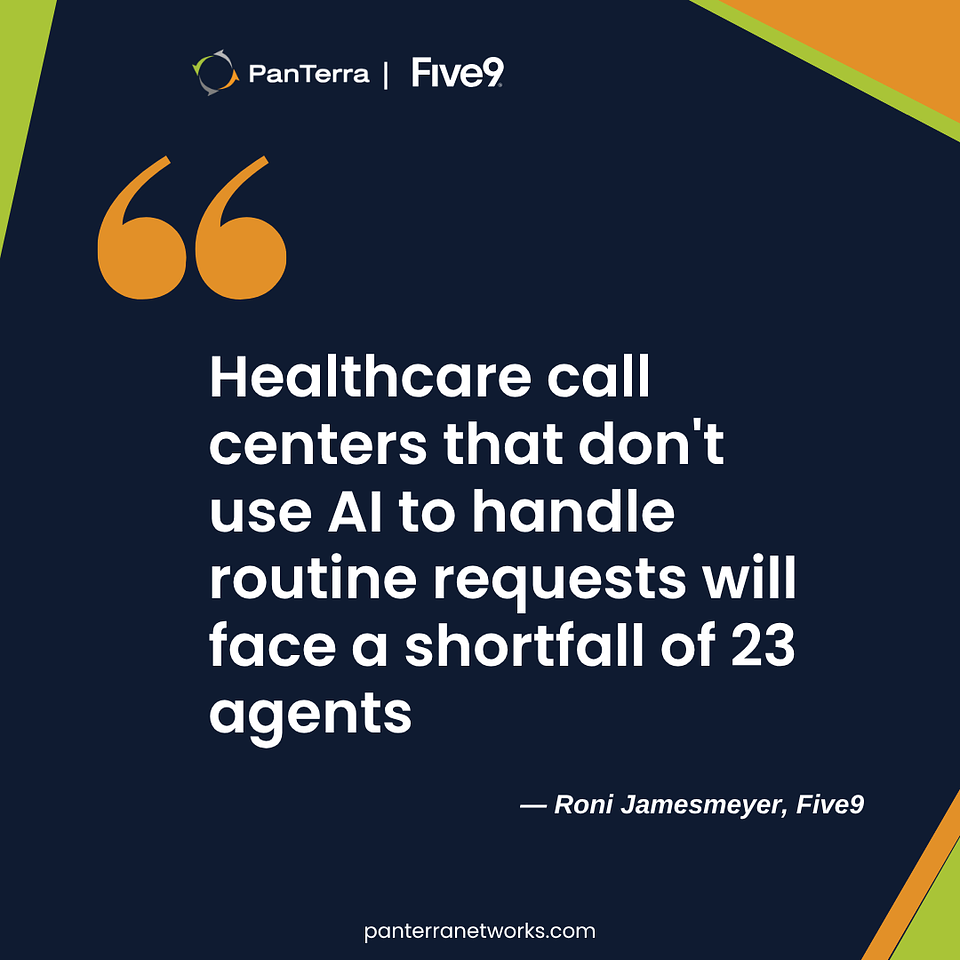
Quote by Roni Jamesmeyer from Five9 about AI patient communication improving efficiency in healthcare call centers.
Real-World Transformation
Three healthcare organizations demonstrate the measurable impact of AI-powered communication:
US Radiology Specialists processes 2.4 million calls annually across multiple imaging centers.
Before implementing AI, over 6,500 calls monthly were routed incorrectly, requiring staff to handle each call twice. Their complex IVR system with eight menu options frustrated patients who couldn't
remember options past the fifth prompt.
Results after AI implementation:
- $4 million in previously lost revenue recovered
- 25% increase in call volume (capturing previously abandoned calls)
- Eliminated need to hire 15 additional agents
- 22 seconds saved per call through intelligent routing
- Full ROI achieved within three months
Exact Sciences, makers of the Cologuard test kit, faced overwhelming call volumes across multiple
service lines including UPS pickups, provider inquiries, and critical 24/7 cases.
Their AI deployment delivered:
- 15 FTEs worth of work automated on the UPS pickup line alone
- 6% of total call volume now handled by AI (targeting 20%)
- Direct integration with Epic EHR for proactive patient outreach
Penn Medicine, managing 5 million calls annually with over 800 agents, discovered patients were
making an average of two additional calls just to reach the right specialty department. Their 35% IVR
abandonment rate was creating significant patient access issues.
Post-AI metrics show:
- Call abandonment reduced from 35% to 20%
- 10% increase in new patient appointments
- Bilingual support in English and Spanish
- Streamlined routing eliminating unnecessary transfers
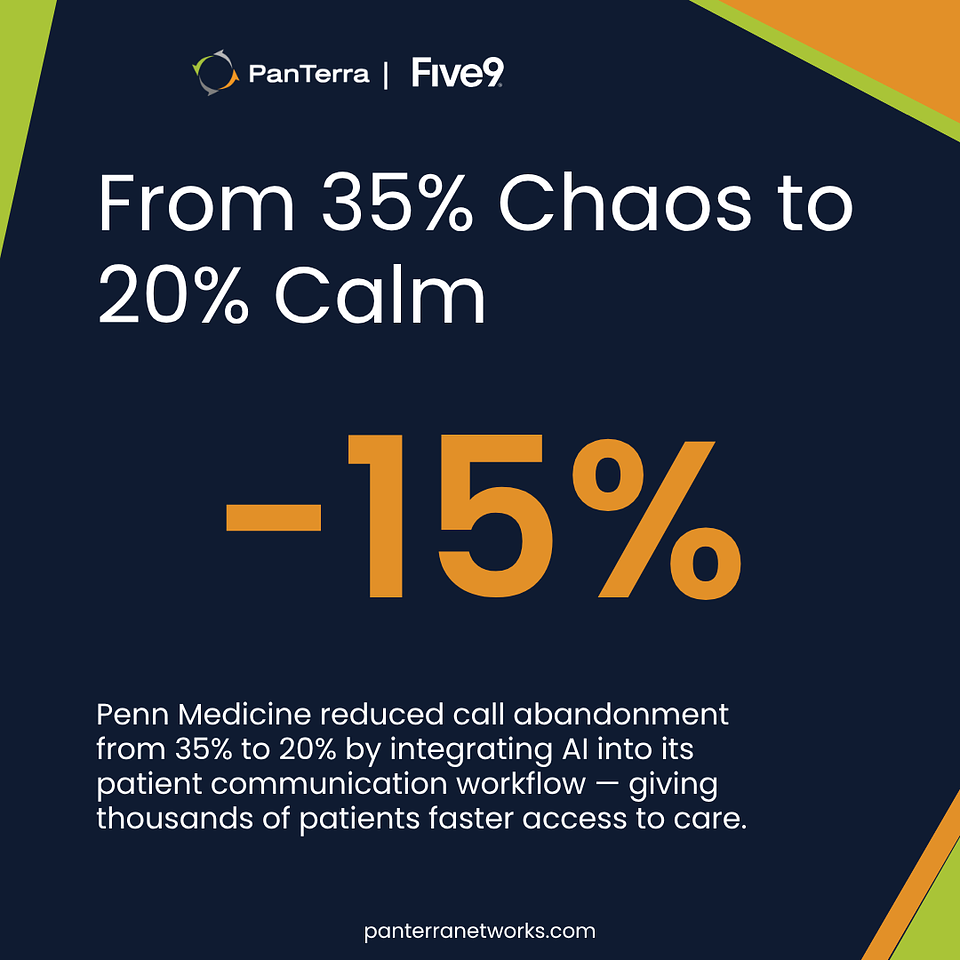
Penn Medicine improves AI patient communication with 15% reduction in call abandonment.
The Technology Making It Possible
The breakthrough comes from combining PanTerra's Luna AI intelligent receptionist with Five9's
advanced contact center capabilities, now featuring the industry's first native integration with
Epic—the electronic health record system used by 36% of U.S. hospitals.
"We're not talking about AI that frustrates the patients or creates more work for the staff," said Shawn Boehme, Director of Sales at PanTerra Networks. "We're talking about AI that actually improves both the patient experience and operational efficiency. Gone are the days of calling into a phone number and having to listen to that auto attendant".
During live demonstrations, the integrated system showcased:
- Natural language processing that eliminates traditional "press 1 for..." menus
- Voice biometric authentication ("My voice is my password")
- Automated appointment scheduling with SMS confirmations
- Prescription refill processing in under two minutes
- Seamless handoff to human agents with full context preserved
"We're seeing a reduction in handle time by about 33% just deploying an auto summary," explained
Neal Pearson, Partner Technology Manager at Five9.
The Human Element
The technology showcased reveals how AI enhances rather than replaces human interaction. As
Pearson showed during the live demo, virtual agents handle routine tasks like appointment
scheduling and prescription refills, freeing staff to focus on complex patient needs.
The system's 24/7 availability means routine questions get answered immediately, while human agents remain available for cases requiring empathy and complex problem-solving.
Industry Implications
The Epic integration announcement marks a watershed moment for healthcare technology adoption.
With Epic's 36% market share, this native integration removes previous middleware barriers that
prevented many organizations from deploying AI solutions
"Our healthcare providers have been asking for this for a couple years now, and we listened," said
Jamesmeyer, referring to the Epic integration.
For healthcare executives evaluating AI solutions, the metrics provide a compelling business case:
typical ROI within 3-6 months, measurable improvements in patient access, and significant
operational savings that can be redirected to patient care initiatives.
The combination of PanTerra's unified communications platform with Five9's AI-powered contact
center capabilities represents a significant step forward in addressing healthcare's communication
challenges.
Watch the full webinar here:
About the Webinar:
Healthcare organizations can access the complete webinar recording, including live demonstrations of the Epic integration and AI agent interactions, at this link. The session features detailed
implementation timelines and additional case studies from healthcare facilities across the United
States.
Media Contact: PanTerra Networks
Contact information:
For more information, please visit www.panterranetworks.com or call us at +1 800.805.0558 or email us at info@panterranetworks.com.